~Kalen
Showing posts with label Paintball Gear. Show all posts
Showing posts with label Paintball Gear. Show all posts
Sunday, February 14, 2016
TiPX Tips
Two posts in one day!? That's a rare thing for me, but I have been pretty amped about this coming paintball season. The ideas are just flowing in, and I thought I would share a video that I posted a couple of weeks ago on my new paintball channel. The channel is called Mongoose PB, and I will be posting any video content that I produce there going forward. Here's the video that I posted which highlights some of the TiPX tips that I found online, and some that I came up with on my own. I hope you enjoy!
~Kalen
~Kalen

Marker Project 2016 - TiPX Loadout (Work in Progress) Part 1
I've decided to do a series of blog entries as I build my first mag fed loadout for the upcoming paintball season. My objective is to help others learn from my research as I go into this as a newcomer to the world of mag fed paintball. I spent some time in my last post going over my rationale for choosing the Tippmann TiPX for my first marker, so I won't spend much time reviewing that. Instead, these posts will serve to mark my progress as I buy kit pieces to form my new loadout.
Let's start with the marker itself. There are two main choices to consider when shopping for a TiPX. There is a standard package which includes the TiPX marker with two 7 round true feed magazines, a spare parts kit, and a hard carrying case. This package sells for $219.00 (U.S.) from most paintball retailers. The second option is Tippmann's deluxe TiPX package which substitutes the hard case for a drop holster and an extra magazine. Tippmann sells this second option for $249.00 (U.S.). Each of the standard kits features a black TiPX, but buyers are also able to purchase the same package with a TiPX in Coyote Brown or OD green for an additional $20.00.
 |
| TiPX - All Stock |
I personally opted for the black TiPX with the deluxe kit so that I would have a carrying option and a spare magazine. I'm not entirely sure if I will continue to use the standard magazines once I have all of my kit components assembled, but that has yet to be determined. After adjusting the drop holster that Tippmann provided, I have some reservations about using it as a viable way to carry the marker if I use my TiPX as a secondary on the field. The fit and overall size of the holster make it feel somewhat unwieldy and bulky when worn on the upper thigh, but perhaps the fit just needs some more fine tuning.
The only other accessory that I have purchased for the marker at this time is an after market barrel. I must admit that my initial reason for buying the barrel was for use on my Tippmann A5 rather than for the TiPX specifically. I originally purchased an 8 inch Lapco Bigshot Assault barrel in their 0.690" bore size. The 8 inch barrel is actually designed for the TiPX, as it has a smaller outer diameter than Lapco's other barrels to fit into the marker's barrel shroud. I like the length of this barrel for the A-5 as well as I tend to prefer getting up close into CQC distances where having a smaller marker length profile is necessary.
Having a better after market barrel for the TiPX also means improved efficiency and accuracy as a primary marker, and all of the reviews that I found for the Lapco Bigshot Assault indicated that it was a very good barrel for round balls. This barrel is a bit on the pricey side with an MSRP of around $57.00, but the gains in performance are substantial enough to justify the upgrade.
I did also buy a Lapco Apex 2 adapter which is compatible with the Bigshot Assault. I'm not sure if I will end up using an Apex tip with the TiPX, but mounting it to the marker gives it a very cool, stealthy aesthetic. I'll have to test out the practicality of the attachment before making my final verdict. My original plan was to use the adapter for my A-5 as I found the original barrel that came with the Apex 2 tip to be too long and heavy.
 |
| Aggressively Cool (TiPX with Lapco Bigshot Assault Barrel, and Apex 2 adapter) |
That's all I have for this first part of my marker project series, but I have quite a few kit and marker upgrades in mind for this marker and for my loadout. I will continue to post updates as updates are added. Until next time.
See you on the field!
~Kalen
Monday, January 18, 2016
Going Mag-Fed?
It has been a long time coming, but I was finally able to put in an order for my new Tippmann TiPX yesterday (01/13). I’ve been looking to try out mag fed for quite a while now, but didn’t really have a good idea of where to begin. There were a lot of variables to consider because going mag fed is a big commitment. Playing with limited paint is very different from what I am used to, and I wasn’t too keen on the idea of getting a full blown mag fed marker only to find out that I didn’t like the play style.
Most of the entry level mag fed markers that I researched included parts allowing them to be converted to accept a hopper, but the utility of attaching a hopper is somewhat of an afterthoughtwith a rifle-sized marker that is built around a magazine feed platform. The whole point of eliminating the hopper is to open up the sight line along the top of the marker, but I’m sure there are those who use the conversion to suit various situations.
The more I thought about it, the more I realized that I didn’t want to commit so fully right off the bat. What I needed was something that would help ease the transition to mag fed. The TiPX seemed like the obvious choice, and I knew that the TiPX could always be used as a secondary marker if I fully buy into mag fed as my primary play style and add more markers to my collection in the future.
For now, I plan to use the TiPX to supplement the A-5 woodsball loadout that I have pieced together for the coming spring. I plan to finally implement some of the pacing limitations that I had talked about using last year, and I may eventually develop a TiPX primary loadout if I build up my proficiency with the marker. Stay tuned for a follow up entry in the coming weeks as I’ll try to post some pictures of my full loadout once all of the pieces are in place.
I may even make a short video on the TiPX and the different things I have planned for the marker for this year. That’s all I have until next time, though.
Play on, everyone!
~Krimmit
Most of the entry level mag fed markers that I researched included parts allowing them to be converted to accept a hopper, but the utility of attaching a hopper is somewhat of an afterthoughtwith a rifle-sized marker that is built around a magazine feed platform. The whole point of eliminating the hopper is to open up the sight line along the top of the marker, but I’m sure there are those who use the conversion to suit various situations.
The more I thought about it, the more I realized that I didn’t want to commit so fully right off the bat. What I needed was something that would help ease the transition to mag fed. The TiPX seemed like the obvious choice, and I knew that the TiPX could always be used as a secondary marker if I fully buy into mag fed as my primary play style and add more markers to my collection in the future.
For now, I plan to use the TiPX to supplement the A-5 woodsball loadout that I have pieced together for the coming spring. I plan to finally implement some of the pacing limitations that I had talked about using last year, and I may eventually develop a TiPX primary loadout if I build up my proficiency with the marker. Stay tuned for a follow up entry in the coming weeks as I’ll try to post some pictures of my full loadout once all of the pieces are in place.
I may even make a short video on the TiPX and the different things I have planned for the marker for this year. That’s all I have until next time, though.
Play on, everyone!
~Krimmit
Sunday, December 27, 2015
Goals for 2016
The new year is right on the Horizon, so I thought it would be a good idea to dust the cobwebs off of the blog here and post about some of my goals for 2016. I didn't accomplish nearly as much as I would have liked in 2015, and many of my goals went unfulfilled, but I'm motivated this year. I have some interesting ideas that I would like to implement, and if I only get a couple of these things started, I'll be happy. Lists are my favorite, so here it goes in order of importance.
1) Blog More!
I really failed on keeping this think consistent last year, but I keep giving myself excuses to ignore my promises to post more often. The posts don't even need to be perfect or ground breaking, I just need to write them. There is no excuse for not doing so when I have access to the mobile app, and some private time during the weekends where I could get these things accomplished. This is one thing I can't ignore anymore.
2) Get Back in Shape
If there's one excuse I've used more often than any other to ignore my passions and to avoid leaving the house in general, it would have to be my weight. I'm not a naturally fit person, and I don't typically enjoy doing physically strenuous stuff, but I've gotten to the point where I feel pretty awful most of the time. My body is clearly starting to give me some warning signs that I can't ignore any longer, so it's time for action.
Being over weight doesn't necessarily preclude a person from playing paintball, but it definitely changes the way I play the game and limits my options for play styles. I'm going to lose the weight this year, and keep it off.
Sorry for the personal stuff. Let's move on to the more superficial.
3) Try Different Styles of Paintball Play
I've been toying with the idea of trying to change my tactics, and to really improve my skills on the field for some time now. The most practical way to do this is to play more often, but I think it's also important to challenge yourself in specific ways as well. During my trips to the field last year, I felt like I was shooting way too much, and not playing tactically enough, so this year I'm going to focus on conserving paint and using the field to my advantage.
I've recently ordered a couple of items to upgrade/modify my Tippmann A-5 that I plan to put to good use this year. These parts will help me set up my first limited paint loadout, and to work on my awareness on the field. I'll post some pictures, and maybe another video when I get the upgrades I ordered.
I'm also working on saving up for a mag-fed marker which is something that I've wanted for as long as I've been playing. Overall though, I'm going to focus less on getting new markers this year and more on how to use the equipment I already have more effectively.
4) Learn Not to Rely on My Friends to Plan Field Time
It was hard to get people to actually play along with me this past year, and I sent out invites on several different occasions with no responses. While this was frustrating, it also served as a reminder that you can't rely on others to enjoy yourself if they aren't as enthusiastic about something as you are. I know several of my friends would have liked to play, but sometimes life just gets in the way. This year, I plan to get a year pass to my favorite field, and to go when it's convenient for me even if that means going alone.
5) Be More Involved in the Paintball Community
I said this last year too, but I already have my foot in the door with some paintball communities, and it would be great to hook up with some other players who share my enthusiasm for this hobby. Nothing is certain yet, but if I can become a part of a more organized group, then I would be very happy and have something to really look forward to in the coming months.
6) Bring More Content to the Blog
Since my hobby budget isn't as extensive as some other player's, I need to find some creative ways to bring more content to the blog. I've really been looking for a cost effective way to get some more video content included on these posts, and by the summer time I may even be able to record gameplay if I can get enough money together. I think that will be a great addition, but playing actual games will be a priority before recording any footage.
The important thing to remember here is that I don't need to be in a rush to spend a lot of money on something that won't pay off in the end anyway.
This list wasn't as long as it could have been, but I don't want to beat myself up over some of my shortcomings from 2015 either. The goal here is to set goals that are more easily obtainable rather than setting the bar so high that I won't reach it. Some of the goals may evolve over time as well, so it's just a matter of digging in and trying to make some of them real. I'll try to set posts to be delivered on a bi-weekly basis, and see how that goes.
Even if nobody reads this, it's nice to reflect on where I started, and to let that be a guide for where I want to end up.
Here's to the New Year, and I hope that everyone has a great year to come!
~Krimmit
~Krimmit
Tuesday, September 8, 2015
Paintball Gear Shopping Tips and Traps
Paintball is a simple enough sport to play conceptually speaking, but purchasing paintball gear can be confusing for a new player or for parents of young players who may not know what they are really looking for. There certainly isn’t any lack of variety in what products or name brands are available for consideration, but one of the biggest challenges for consumers is choosing cost over functionality. If everyone had the budget to purchase only the most expensive gear, apparel, and accessories then building a start up kit would be easy, but that is rarely the case for those of us who are “budget ballers”.
The plain and simple truth is that paintball is an expensive hobby for people looking to own the equipment they use regularly, and buying the wrong item or an item that doesn’t work as expected is a big deal. This problem can be aggravated by the fact that many of us don’t have an actual “brick and mortar” retail store where we live that specializes in paintball equipment. There may be stores that have a few items, or they might sell the bare minimum odds and ends, but there are some seriously steep drawbacks to buying items this way.
Today’s post will be about making informed purchasing choices over the internet from retailers and private sellers alike. As someone who has made some mistakes, I can offer up some advice about what items and situations to avoid as you build your collection of paintball gear. I have also linked a video below that I made specifically explaining the pitfalls of buying paintball masks online without the ability to “try before you buy”, so check that out as well if you have a free 20 minutes or so.
Let’s first address the issue of going to a standard sporting goods retailer to purchase paintball gear. We all probably have stores like Dick’s Sporting Goods, Scheel’s, Walmart, and so on in our home towns that offer a limited selection of paintball items that they typically lump together with cheap BB Guns near the hunting and shooting supplies. They normally sit on bottom shelves out of normal view, and the dusty boxes and sealed plastic packaging normally show just how little attention they get from average shoppers. This is typically reason enough not to purchase most of the things you need from a normal department store retailer, but we’ve all been tempted at one point or another.
Many uninformed shoppers, or budget ballers are easily tempted by what looks like a good deal on the rack, but most of the items on these displays are barely worth the clearance close out pricing offered. However, it is normally safe to buy some of the more common items all players need from these types of stores. Items like CO2 tanks, O-Rings, cheap lubricants, and inexpensive gravity hoppers are all worth picking up if you don’t want to wait for shipping since the quality varies so little from what you would find at a specialty store. Some stores even carry decent start up markers like the Tippmann 98 Custom, select Spyder markers, and they may even carry passable recreational grade paint as well. These can be worth buying as long as they aren’t marked up above the average online price.
Always be careful about buying paint from these retailers, and make sure you ask to open and inspect the box for broken or dimpled paintballs before checking out. Spending $40+ on low grade paint only to have every ball break or curve like crazy is the equivalent of lighting your money on fire and throwing it on the ground before walking on the field. Another drawback to buying from these stores is that the staff typically has no idea how the items they are selling actually perform. Since the products are often lumped in with hunting and shooting supplies, the clerks most likely only have cursory knowledge of paintball gear since they are far less popular than the other enthusiast stock they sell. The lesson to learn here is that just because something is cheap or convenient doesn’t mean that it will help you in the long run. Take the time to do some research before picking anything up from a department store, and make sure you verify that the pricing they offer lines up with what specialty retailers charge for the same or similar items.
Buying directly from specialty stores online or through mega-retailers like Amazon.com can be less daunting due to the fact that there is normally quite a bit more information available on these sites from the retailers and other shoppers alike. However, variety is the real enemy here, and it can be easy to get lost in the dozens of pages of items each vendor is selling. Luckily, most of these vendors have options to filter your search results to find items within your price range and required feature limitations. Most undesirable items can be weeded out of your search results this way, and if you are in doubt about a product you can likely find more comprehensive information about the product you like on enthusiast websites or on blogs like this one!
The biggest and most obvious drawback to buying online is that it is impossible to physically try or handle the product that you are shopping for which is particularly important when buying clothing or apparel. Online photos can be misleading, and they can often misrepresent the actual physical look or fit of an item. It is particularly difficult to find sizing references for apparel items like jerseys or paintball pants online which often just list sizes (Large, X-Large, etc.) and finding actual measurements can take a little bit of digging. Make sure you always review a vendor’s return policy details for information about return shipping fees or restocking penalties before buying. Also, make a habit of doing too much research about a product before you buy it to see if there are any hidden issues that other consumers have found.
A product may look perfect once you open the box, but then it may not work or fit as desired once you get it. Take some consumer reviews with a grain of salt, and make sure to read other reviews from a source if possible. If they sound like a person who just likes to complain or misinform about everything they buy then don’t even pay attention to their input. Retail sites are not immune to trolling comments any more than blogs or social media and community websites are.
Last but not least is purchasing used equipment online from other enthusiasts. Buying someone’s used paintball gear is like buying any other used items from another person. Every purchase is a gamble, and there is very little protection for the buyer if something goes wrong unless you personally know the seller. There are many ways to get used items, and there doesn’t seem to be one option that is safer than any other. Ebay is perhaps the most secure since PayPal has some safeguards in place to protect buyers, but if a seller is smart they most likely have disclosed enough “as is” language for items which can be difficult to combat if you buy a lemon.
There really isn’t a fool proof method for buying used gear, but a smart shopper should be able to use common sense to judge if a price is not right for a used item. Ask a lot of questions about the thing you are considering, and do your research about value depreciation. Some reputable websites will sell used gear that customers send in for trade, and they can be a fairly good reference point for what a previously owned item is worth at retail value. Use this information to haggle when possible. Finally, if you are answering a Craigslist ad, always ask to carefully inspect the items you are buying before paying for anything. To be honest, Craigslist creeps me out like nobody’s business, so I never look on there anyway. I’ve heard too many horror stories.
The best way to get used gear is by trading or purchasing items from other players at the field if they are looking to sell. There is still no guarantee that you won’t get fleeced somehow, but at least you have the ability to try what you buy at the field before shelling out any cash. I haven’t personally come across anyone selling items at the field I play at so far, but it does happen.
I hope this will be a helpful guide to some of you, but we are always bound to slip up and make a mistake from time to time. If we didn’t, then there wouldn’t really be any reason for a post like this in the first place. My best advice is just to do a ton of research when possible. It might seem like you are over thinking your purchases, but good gear goes a long way in this sport. Bad gear will put you on the sidelines in a hurry. To those parents buying paintball gear for their kids but don’t necessarily have any knowledge about the sport themselves, always ask why they want the things they are asking for. If you can’t weed out a reasonable need, then shop for a comparable alternative every time.
That’s all for now.
See you on the field!
Sunday, July 5, 2015
Gear Bag Review #5
Welcome back to the final entry in my series detailing my personal beginner’s paintball kit. In this entry, I will be taking a look at some of the “optional” pieces of kit that I have recently purchased to supplement my own gear bag. I consider these items optional because even though they are items specifically marketed for paintball, they aren’t necessarily going to make or break the way that you play the sport. Most of the items in the following article can be substituted with every day items you may already have around the house, so don’t feel obligated to purchase these items to be a proficient player.
Paintball Jersey
A good jersey serves multiple functions. First and foremost, a jersey is typically made of light, breathable material that can be worn as a protective layer in a wide variety of environments. The material is not typically thick enough to reduce the felt impact of paintballs, but it is still better than being hit one bare, unprotected skin. The semi rigid shells of paintballs will cut exposed tissues when it breaks if the circumstances are right. It’s happened to me, and others that I play with, enough said. Some jerseys are brightly colored, and others are patterned with camouflage.
I recently bought a Valken V-Tac Jersey, though I have been playing with old, beaten up clothing previously. I’m not ashamed to say that this was mostly inspired by the look of the jersey, but my decision was also prompted by the fact that most long sleeve shirts are simply too warm to wear during the summer months of play. I haven’t worn the jersey out on the field yet, but it was very comfortable to wear around the house, and the venting seemed adequate to keep things moderately cool during warmer days. Again, jerseys are in no way required, but they do add something to the aesthetic appeal of a well complimented paintball uniform.
Head Wrap
I had been wearing a couple of cheap $1.00 bandannas while playing, but I wanted something more subdued that would have a padded band to protect the sides of my head and my forehead while playing. The Valken V-tac head wrap that I recently bought fits the bill nicely, and it is easy to tie or untie between matches. Don’t feel the need to shell out $20.00 for a head wrap if you don’t want to. In fact, I may still alternate this between wearing a backwards facing ball cap depending on how I play and where.
Remote Line/Coil
Whether this is an optional item may be debatable depending on what marker you use, and what variety of paintball that you play. I purchased my Ninja Remote Coil because I felt that the Tippmann A-5 I will be using is too heavy with a CO2 canister attached directly to the marker’s ASA. Having a 20 oz. tank screwed onto the grip also makes the marker much longer and more awkward to hold up whereas using a remote line allows the marker to be held closer to your face and body. Doing so makes peaking corners much easier. This is another item that I have yet to field test, but using this along with the vest rig I mentioned in my previous post seems like the optimal way to run with a heavier marker when competing with smaller, lighter electro markers.
This particular coil also has a remote check valve that allows you to cut off the air supply to your marker without needing to disconnect the line from your tank. Having this ability is particularly handy for saving air or CO2 that is normally wasted while screwing and unscrewing a tank directly from the marker itself. There are many different remote lines available to choose from, but try to avoid buying anything that seems like it might be a better deal than is reasonable. Price is tied to quality with these items, and I have read many accounts of players getting burned (in the financial sense) by cheap, leaky remote hoses.
That pretty much wraps it up for my personal gear bag review. Aside from the various tools, cleaning cloths, and other miscellaneous items that I won’t bother to mention, I have listed every item that I currently own and use to play paintball. There are a few items that I recently ordered that didn’t make the list, but I will talk about those later on when I discuss upgrades, and share my overall views on playing this sport. I haven’t spent nearly enough time on commercial fields yet to discuss strategy or give gameplay advice, but I will post future entries with links to articles and videos that I find helpful when approaching the game.
Sorry there aren't any pictures of my gear this time. I lost the files, and didn't have the time to take more with my phone for upload.
Until next time!
~Krimmit
Paintball Jersey
A good jersey serves multiple functions. First and foremost, a jersey is typically made of light, breathable material that can be worn as a protective layer in a wide variety of environments. The material is not typically thick enough to reduce the felt impact of paintballs, but it is still better than being hit one bare, unprotected skin. The semi rigid shells of paintballs will cut exposed tissues when it breaks if the circumstances are right. It’s happened to me, and others that I play with, enough said. Some jerseys are brightly colored, and others are patterned with camouflage.
I recently bought a Valken V-Tac Jersey, though I have been playing with old, beaten up clothing previously. I’m not ashamed to say that this was mostly inspired by the look of the jersey, but my decision was also prompted by the fact that most long sleeve shirts are simply too warm to wear during the summer months of play. I haven’t worn the jersey out on the field yet, but it was very comfortable to wear around the house, and the venting seemed adequate to keep things moderately cool during warmer days. Again, jerseys are in no way required, but they do add something to the aesthetic appeal of a well complimented paintball uniform.
Head Wrap
I had been wearing a couple of cheap $1.00 bandannas while playing, but I wanted something more subdued that would have a padded band to protect the sides of my head and my forehead while playing. The Valken V-tac head wrap that I recently bought fits the bill nicely, and it is easy to tie or untie between matches. Don’t feel the need to shell out $20.00 for a head wrap if you don’t want to. In fact, I may still alternate this between wearing a backwards facing ball cap depending on how I play and where.
Remote Line/Coil
Whether this is an optional item may be debatable depending on what marker you use, and what variety of paintball that you play. I purchased my Ninja Remote Coil because I felt that the Tippmann A-5 I will be using is too heavy with a CO2 canister attached directly to the marker’s ASA. Having a 20 oz. tank screwed onto the grip also makes the marker much longer and more awkward to hold up whereas using a remote line allows the marker to be held closer to your face and body. Doing so makes peaking corners much easier. This is another item that I have yet to field test, but using this along with the vest rig I mentioned in my previous post seems like the optimal way to run with a heavier marker when competing with smaller, lighter electro markers.
This particular coil also has a remote check valve that allows you to cut off the air supply to your marker without needing to disconnect the line from your tank. Having this ability is particularly handy for saving air or CO2 that is normally wasted while screwing and unscrewing a tank directly from the marker itself. There are many different remote lines available to choose from, but try to avoid buying anything that seems like it might be a better deal than is reasonable. Price is tied to quality with these items, and I have read many accounts of players getting burned (in the financial sense) by cheap, leaky remote hoses.
That pretty much wraps it up for my personal gear bag review. Aside from the various tools, cleaning cloths, and other miscellaneous items that I won’t bother to mention, I have listed every item that I currently own and use to play paintball. There are a few items that I recently ordered that didn’t make the list, but I will talk about those later on when I discuss upgrades, and share my overall views on playing this sport. I haven’t spent nearly enough time on commercial fields yet to discuss strategy or give gameplay advice, but I will post future entries with links to articles and videos that I find helpful when approaching the game.
Sorry there aren't any pictures of my gear this time. I lost the files, and didn't have the time to take more with my phone for upload.
Until next time!
~Krimmit
Tuesday, February 17, 2015
Gear Bag Review #3
Welcome to part three of my gear bag review. I’ve already written about the two most important pieces of kit when I covered my markers and mask, so the next few posts will lump different pieces of gear together. As promised, I will create a master link to this series that will allow people to jump to different pages by clicking on the name of a certain piece of gear. I will also add in a price guide so that new players can get some idea of what it costs to build their first paintball kit.
Gloves
Not everyone wears gloves on the paintball field, but I would highly recommend buying something to protect your hands during play. Getting hit directly on the finger by a paintball is very painful, and it happens more often than you would think. Also, gloves help to protect your hands when you are moving through brush or scrambling to get behind low cover. There are a lot of gloves made for paintball or airsoft, but don’t feel like you need to use special gloves if you can’t afford them.
My first pair of gloves was a simple set of re-purposed utility gloves that I had bought to help my friend remodel his basement a couple of years ago. They have leather grips, padded knuckles, and an adjustable Velcro strap to adjust for fit. They worked perfectly, but started to wear on the finger tips, so I had to remove the tip of the index finger for my left hand (my shooting hand). I technically didn't need to replace them, but I had another landscaping project and decided to purchase another pair of work gloves at Walmart.
This pair is bright red, and though I could use them to play paintball, I feel like they would basically stand out as a dead giveaway if I tried to sneak through the brush. I decided to buy some Mechanix Mpact gloves specifically for paintball, because I had read on some forums that players were using them for paintball and airsoft. They have more padding in specific areas, but I’m on the fence about them at this point. For the most part, they cost a great deal more than my cheap utility gloves, and they have some issues with stiff material that has been stitched on the thumb and forefinger. This material deadens my sense of touch so that I can’t really feel the trigger as well, so they may need to be broken in a bit. If they don’t work, I will likely try to get a different pair to play with.
My advice to anyone looking to buy gloves is to avoid using anything that is too thick or restrictive. Winter gloves (snowboarding gloves, convertible mittens, etc.) are really to bulky to be functional, so use something that is protective, but natural feeling. If you are interested in Mechanix Wear gloves, they are sold online, or some styles can be found at automotive supply stores or hardware stores. If you are buying online, be careful about sizing, as the fit will be different than other brands. They have an online sizing chart that you can print for reference.
Hoppers
I won’t go into much discussion about hoppers in general here, because I have only ever used two hoppers since I started playing. My original hopper is a simple, gravity fed JT hopper that I bought for around $6.00. It works well with a mechanical marker, holds quite a few paintballs and I have no complaints about it other than the fact that it isn't a good fit for an electronic marker.
My second purchase was the Empire Halo Too electronic hopper which I use with my electronic marker. I really like this hopper despite some of the issues I have with the programming interface and with disassembly/reassembly. It feeds very consistently without breaks or jams, and I haven’t had a single issue with mechanical failures that could be attributed to the hopper itself. I can’t say the same about my marker, but I digress. Some players prefer the more popular and expensive Dye Rotor hoppers, but I don’t really have the need for something like that just yet. Besides, I plan to make my Tippmann A-5 my primary marker this season, and it doesn’t require any after market hopper at all!
The short answer about purchasing a good hopper is to do as much research as possible. It’s not a terrible idea to go ahead and purchase a Dye Rotor, but it’s not necessarily the most budget friendly decision either. It is important to know the limitations of your marker as well. If you can only fire 15 to 20 balls per second with your marker, there is no need to purchase a hopper that can load faster than that unless you plan to upgrade your marker frequently. Buying a hopper all comes down to personal preference, and there are no real wrong choices. Just make sure that your hopper doesn’t hinder your marker’s performance.
That’s all I have for this post as I’m trying to keep these short(ish), but next time I will write about my pod carriers and air tanks along with some smaller extras that I have recently purchased to augment my loadout. If you have comments or questions/suggestions about items from my kit that you would like to know more about, then please feel free to use the comments section below. Until the next time!
~Krimmit
Gloves
 |
| Standard utility gloves left and center. Mechanix MPact Gloves on the Right. |
Not everyone wears gloves on the paintball field, but I would highly recommend buying something to protect your hands during play. Getting hit directly on the finger by a paintball is very painful, and it happens more often than you would think. Also, gloves help to protect your hands when you are moving through brush or scrambling to get behind low cover. There are a lot of gloves made for paintball or airsoft, but don’t feel like you need to use special gloves if you can’t afford them.
My first pair of gloves was a simple set of re-purposed utility gloves that I had bought to help my friend remodel his basement a couple of years ago. They have leather grips, padded knuckles, and an adjustable Velcro strap to adjust for fit. They worked perfectly, but started to wear on the finger tips, so I had to remove the tip of the index finger for my left hand (my shooting hand). I technically didn't need to replace them, but I had another landscaping project and decided to purchase another pair of work gloves at Walmart.
This pair is bright red, and though I could use them to play paintball, I feel like they would basically stand out as a dead giveaway if I tried to sneak through the brush. I decided to buy some Mechanix Mpact gloves specifically for paintball, because I had read on some forums that players were using them for paintball and airsoft. They have more padding in specific areas, but I’m on the fence about them at this point. For the most part, they cost a great deal more than my cheap utility gloves, and they have some issues with stiff material that has been stitched on the thumb and forefinger. This material deadens my sense of touch so that I can’t really feel the trigger as well, so they may need to be broken in a bit. If they don’t work, I will likely try to get a different pair to play with.
My advice to anyone looking to buy gloves is to avoid using anything that is too thick or restrictive. Winter gloves (snowboarding gloves, convertible mittens, etc.) are really to bulky to be functional, so use something that is protective, but natural feeling. If you are interested in Mechanix Wear gloves, they are sold online, or some styles can be found at automotive supply stores or hardware stores. If you are buying online, be careful about sizing, as the fit will be different than other brands. They have an online sizing chart that you can print for reference.
Hoppers
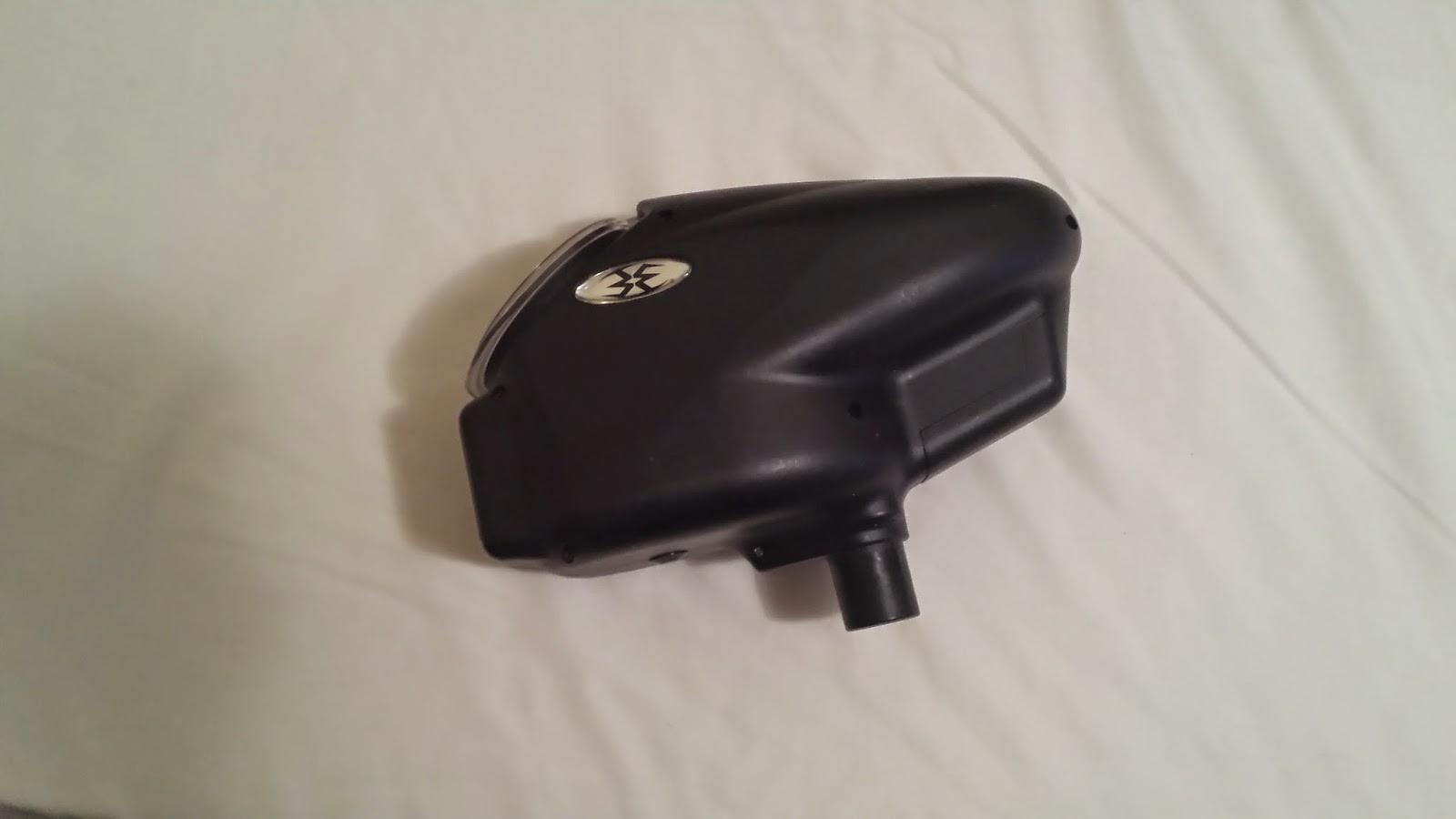 |
| Empire Halo Too electronic hopper |
I won’t go into much discussion about hoppers in general here, because I have only ever used two hoppers since I started playing. My original hopper is a simple, gravity fed JT hopper that I bought for around $6.00. It works well with a mechanical marker, holds quite a few paintballs and I have no complaints about it other than the fact that it isn't a good fit for an electronic marker.
My second purchase was the Empire Halo Too electronic hopper which I use with my electronic marker. I really like this hopper despite some of the issues I have with the programming interface and with disassembly/reassembly. It feeds very consistently without breaks or jams, and I haven’t had a single issue with mechanical failures that could be attributed to the hopper itself. I can’t say the same about my marker, but I digress. Some players prefer the more popular and expensive Dye Rotor hoppers, but I don’t really have the need for something like that just yet. Besides, I plan to make my Tippmann A-5 my primary marker this season, and it doesn’t require any after market hopper at all!
The short answer about purchasing a good hopper is to do as much research as possible. It’s not a terrible idea to go ahead and purchase a Dye Rotor, but it’s not necessarily the most budget friendly decision either. It is important to know the limitations of your marker as well. If you can only fire 15 to 20 balls per second with your marker, there is no need to purchase a hopper that can load faster than that unless you plan to upgrade your marker frequently. Buying a hopper all comes down to personal preference, and there are no real wrong choices. Just make sure that your hopper doesn’t hinder your marker’s performance.
That’s all I have for this post as I’m trying to keep these short(ish), but next time I will write about my pod carriers and air tanks along with some smaller extras that I have recently purchased to augment my loadout. If you have comments or questions/suggestions about items from my kit that you would like to know more about, then please feel free to use the comments section below. Until the next time!
~Krimmit
Thursday, February 12, 2015
Gear Bag Review #2
Welcome back for part 2 of my personal gear bag review. In this series, I’m basically just talking about the different pieces of equipment that I have in my own beginner’s kit for paintball and my reasons for purchasing those items. If any of the information I share in these posts can help others make informed choices about their own first purchases, I would be very happy to hear it.
Feel free to share any of your own thoughts about the best equipment to buy first, or what items to avoid in the comments below the posts. I will put up one master post with a list of links to the items listed once the series is finished, and I also plan to put together a price guide for the very first items I bought so that you all can see what a beginner’s kit can cost.
Paintball Masks
A good mask is probably the most important part of any gear bag, and it is really the most vital and universally required piece of equipment for playing on any commercial paintball field. The most important thing to know about paintball masks is that if it seems like too good of a deal to be true, it most likely is. My very first mask is really the only piece of kit that I fully regret buying. There’s a little bit of back story here, but I will be brief.
For my very first paintball outing, my friends and I decided to play in the dead of winter, and the only gear that I actually owned for playing was a marker, and a tank that my wife had picked up for me the night before. We all met at our local sporting goods store to pick up paint, fill our tanks, and see what other gear we could find. Most stores in my area don’t stock up on paintball supplies too heavily, so pickings were slim that day. However, I did spot a JT hopper for my mechanical marker and a JT mask for about $25.00 on the shelf above. I didn’t have a mask of my own, and I knew very little about what features to look for at the time.
We all left the store with our new items in hand, and drove out to the woods for a few games. After about 20 minutes of playing, running, and breathing into the mask, the lens fogged up so badly that I couldn’t see past the large drops of condensation that had gathered there. I wasn’t sweating, but my skin was breathing moisture into the goggle which was chilled from the cold air outside. To make things worse, the condensation then froze inside my lens rendering me blind and vulnerable.
I chalked that experience up to bad weather, and brought the mask out of storage a few months later when the weather had grown warmer. Even at temps around 50 to 60 degrees Fahrenheit, the mask fogged so badly that I would have to call myself out to avoid running into a tree stump or a ditch unwittingly. The lesson here is to always look for a mask with a thermal coated lens at bare minimum, and that’s where my Sly Profit comes in.
The Profit retails for around $120-$130 on most websites, and once I started playing with this thing, I was running around the field with confidence. Even when temps started peaking around 90 degrees with 100% humidity, my lens stayed clear and the mask is still quite comfortable. My only gripe would be that the Profit is not well ventilated, and it does feel a bit stuffy at all temperatures. Still, I can’t complain about how much better it has been playing with this mask.
I haven’t played with any other masks besides that JT abomination, and my Profit, but I wouldn’t necessarily say that you need to spend over $100 to get a good thermal mask. There are several options available in the $40 + range that seem to have very good reputations from players who are more seasoned than I am. My advice is to do a bit of research before you buy, and choose something that you like both aesthetically, and functionally.
Many players will have strong opinions about masks and other equipment, but don’t follow herd thinking on this choice. Besides, how boring is it to see a bunch of Dye I4s and Empire Profilers running around on the field all day? Both are great masks from what I hear, but a bit of variety is good. Choose something that fits your need, and something that fits your budget.
Until next time!
~Krimmit
Feel free to share any of your own thoughts about the best equipment to buy first, or what items to avoid in the comments below the posts. I will put up one master post with a list of links to the items listed once the series is finished, and I also plan to put together a price guide for the very first items I bought so that you all can see what a beginner’s kit can cost.
Paintball Masks
 |
| Sly Profit Dual-Pane Thermal Goggle |
A good mask is probably the most important part of any gear bag, and it is really the most vital and universally required piece of equipment for playing on any commercial paintball field. The most important thing to know about paintball masks is that if it seems like too good of a deal to be true, it most likely is. My very first mask is really the only piece of kit that I fully regret buying. There’s a little bit of back story here, but I will be brief.
For my very first paintball outing, my friends and I decided to play in the dead of winter, and the only gear that I actually owned for playing was a marker, and a tank that my wife had picked up for me the night before. We all met at our local sporting goods store to pick up paint, fill our tanks, and see what other gear we could find. Most stores in my area don’t stock up on paintball supplies too heavily, so pickings were slim that day. However, I did spot a JT hopper for my mechanical marker and a JT mask for about $25.00 on the shelf above. I didn’t have a mask of my own, and I knew very little about what features to look for at the time.
We all left the store with our new items in hand, and drove out to the woods for a few games. After about 20 minutes of playing, running, and breathing into the mask, the lens fogged up so badly that I couldn’t see past the large drops of condensation that had gathered there. I wasn’t sweating, but my skin was breathing moisture into the goggle which was chilled from the cold air outside. To make things worse, the condensation then froze inside my lens rendering me blind and vulnerable.
I chalked that experience up to bad weather, and brought the mask out of storage a few months later when the weather had grown warmer. Even at temps around 50 to 60 degrees Fahrenheit, the mask fogged so badly that I would have to call myself out to avoid running into a tree stump or a ditch unwittingly. The lesson here is to always look for a mask with a thermal coated lens at bare minimum, and that’s where my Sly Profit comes in.
The Profit retails for around $120-$130 on most websites, and once I started playing with this thing, I was running around the field with confidence. Even when temps started peaking around 90 degrees with 100% humidity, my lens stayed clear and the mask is still quite comfortable. My only gripe would be that the Profit is not well ventilated, and it does feel a bit stuffy at all temperatures. Still, I can’t complain about how much better it has been playing with this mask.
I haven’t played with any other masks besides that JT abomination, and my Profit, but I wouldn’t necessarily say that you need to spend over $100 to get a good thermal mask. There are several options available in the $40 + range that seem to have very good reputations from players who are more seasoned than I am. My advice is to do a bit of research before you buy, and choose something that you like both aesthetically, and functionally.
Many players will have strong opinions about masks and other equipment, but don’t follow herd thinking on this choice. Besides, how boring is it to see a bunch of Dye I4s and Empire Profilers running around on the field all day? Both are great masks from what I hear, but a bit of variety is good. Choose something that fits your need, and something that fits your budget.
Until next time!
~Krimmit
Tuesday, January 27, 2015
My Beginner's Paintball Kit (Paintball Markers)
I know I promised to do a blog about my whole list of gear at the end of my last post, but if I put everything into one entry, it would probably end up being 10 pages long, and nobody would want to read it. Instead, I will make several posts about individual pieces of equipment along with my reasons for purchasing each item. Some posts may have more than one piece type of equipment listed if the entry is too short, so this will be a work in progress. I will post a link tree at the bottom of every entry once all of the items have been discussed so that people can navigate to specific kit pieces if they wish.
It might also be worth disclosing that these first several posts have been put together over a relatively short period of time. That’s mainly because the blog is new, and I have quite a bit of subject material to work with right now. The posts will start to spread out a bit once I have to search for new subject material, so if you have stumbled across this blog recently, be sure to read it from the beginning and follow them in order if possible. If not, that’s fine too. Now, on to the first piece of gear!
My First Marker: Spyder MR100 PRO
This was my very first marker that I purchased just under a year ago when my friends first mentioned that they would be setting up a private course close to where we all lived. However, as you may have noticed, I didn’t follow my own advice to avoid purchasing anything until I played a few times. To be honest, I haven’t really used this on any field since my first outing. The MR100 Pro is a decent beginner’s marker that also proves to be very economical and reliable on the field even though it lacks in rate of fire.
The marker is semi auto, and fully mechanical, and the double trigger does allow for quicker trigger pulls. I run CO2 through this marker along with all of my other markers, and the MR100 doesn’t miss a step. In fact, this marker is very efficient and will get around 1200 to 1300 shots out of a 20oz. CO2 tank. My only complaint is that even though the marker comes with a collapsible stock, I never use it with the stock attached. I find stocks to be a purely cosmetic feature for most paintball markers since wearing a mask doesn’t really allow you to rest your cheek on the stock anyway. Also, there are no sights on the top of the marker due to the position of the feed neck. All in all, this is a good, inexpensive marker.
Marker # 2: Spyder Fenix 2012
I purchase the Fenix because after playing once, I knew I wanted something with an electronic trigger. The field we were playing on was relatively small, and favored encounters that required a lot of suppressing fire, and my semi auto marker wasn’t cutting it. Experienced paintballers are probably rolling their eyes at all of the Spyder markers on this list, and I am aware that they aren’t high quality markers. However, the Fenix did allow me to hold my own against players using much more popular and expensive markers without shelling out over $250.00 even though there were some drawbacks.
I wouldn’t enter any competitions with this marker, but that isn’t my goal anyway. Out of my three markers, this one gets the most use, and I am learning to work around its shortcomings nicely. Will I eventually trade up for a better electronic marker? Most likely, but this is working for me right now. I’ll probably still hold on to the Spyder as a backup for years to come.
Marker # 3: Tippmann A-5 2011 Model (With Added Response Trigger)
Let the eye rolling continue, but I purchased this marker for a few very specific reasons. The first was that I knew once I started playing on larger, more objective based fields that I would want to change my play style. I’m not as young as I once was, and the thought of sliding and diving around the field simply doesn’t appeal to me. That’s not to say that using an electronic marker makes it necessary to jump around the field like a crazy person, but playing with a marker like the A-5 demands a bit of patience and tactical thinking when you are playing against more advanced markers that can fling ropes of paint around the field.
If you never have before, I would suggest watching some videos on YouTube posted by Trails of Doom. Glen, who runs the channel, almost exclusively uses an A-5, and he is able to pull of some crazy, sneaky maneuvers that I have never seen on other channels where players are using newer markers.
It’s all about how you play, and I wanted to use a platform that would force me to approach the game differently. I’ve only used this marker on the field a few times, and I was frustrated by the weight and awkwardness of it after using a much lighter and shorter marker. I have recently purchased a remote line and harness to help alleviate those issues.
Many of my recent purchases have revolved around the use of this new setup, so I hope my choice will pay off in the long run. If not, I have other options in my arsenal, and I can always trade up later on. My other motivations for using the A-5 revolved around Tippmann’s excellent reputation for building some of the toughest, most durable markers on the market. Also, since the A-5 has been around for so long, there are more after market customization options available for this marker than any other still being sold (as far as I know, but correct me if I’m wrong).
I haven’t bothered customizing my own A-5 aside from installing the response trigger upgrade which allows me to fire full auto, but I haven’t tested that on the field as of yet. My biggest concern with the A-5 so far had been the weight, so I don’t want to add any more extras that would further bog me down. I also purchased an Apex 2 barrel kit, but haven’t really had any use for it as the old field was too small and densely packed with foliage to use the higher ramp settings.
There you have it! I will most likely continue to change what markers that I use as I grow into the sport, but I don’t have a huge budget to throw at new markers. Paintball markers are easily the most expensive piece of kit that you will buy for paintball, and while I could have easily spent the money devoted to the purchase of all three of these markers on one monster of a marker, I chose variety over having just one marker.
Perhaps you have different opinions about how a first marker should be chosen. Feel free to leave your first marker purchase choices and stories in the comments below. Until the next time!
~Krimmit
It might also be worth disclosing that these first several posts have been put together over a relatively short period of time. That’s mainly because the blog is new, and I have quite a bit of subject material to work with right now. The posts will start to spread out a bit once I have to search for new subject material, so if you have stumbled across this blog recently, be sure to read it from the beginning and follow them in order if possible. If not, that’s fine too. Now, on to the first piece of gear!
My First Marker: Spyder MR100 PRO
 |
| Spyder MR100 Pro with Stock Removed |
The marker is semi auto, and fully mechanical, and the double trigger does allow for quicker trigger pulls. I run CO2 through this marker along with all of my other markers, and the MR100 doesn’t miss a step. In fact, this marker is very efficient and will get around 1200 to 1300 shots out of a 20oz. CO2 tank. My only complaint is that even though the marker comes with a collapsible stock, I never use it with the stock attached. I find stocks to be a purely cosmetic feature for most paintball markers since wearing a mask doesn’t really allow you to rest your cheek on the stock anyway. Also, there are no sights on the top of the marker due to the position of the feed neck. All in all, this is a good, inexpensive marker.
Marker # 2: Spyder Fenix 2012
 |
| Spyder Fenix 2012 with after market barrel (brand unknown) |
I wouldn’t enter any competitions with this marker, but that isn’t my goal anyway. Out of my three markers, this one gets the most use, and I am learning to work around its shortcomings nicely. Will I eventually trade up for a better electronic marker? Most likely, but this is working for me right now. I’ll probably still hold on to the Spyder as a backup for years to come.
Marker # 3: Tippmann A-5 2011 Model (With Added Response Trigger)
 |
| Stock Tippmann A-5 with Response Trigger |
If you never have before, I would suggest watching some videos on YouTube posted by Trails of Doom. Glen, who runs the channel, almost exclusively uses an A-5, and he is able to pull of some crazy, sneaky maneuvers that I have never seen on other channels where players are using newer markers.
It’s all about how you play, and I wanted to use a platform that would force me to approach the game differently. I’ve only used this marker on the field a few times, and I was frustrated by the weight and awkwardness of it after using a much lighter and shorter marker. I have recently purchased a remote line and harness to help alleviate those issues.
Many of my recent purchases have revolved around the use of this new setup, so I hope my choice will pay off in the long run. If not, I have other options in my arsenal, and I can always trade up later on. My other motivations for using the A-5 revolved around Tippmann’s excellent reputation for building some of the toughest, most durable markers on the market. Also, since the A-5 has been around for so long, there are more after market customization options available for this marker than any other still being sold (as far as I know, but correct me if I’m wrong).
I haven’t bothered customizing my own A-5 aside from installing the response trigger upgrade which allows me to fire full auto, but I haven’t tested that on the field as of yet. My biggest concern with the A-5 so far had been the weight, so I don’t want to add any more extras that would further bog me down. I also purchased an Apex 2 barrel kit, but haven’t really had any use for it as the old field was too small and densely packed with foliage to use the higher ramp settings.
There you have it! I will most likely continue to change what markers that I use as I grow into the sport, but I don’t have a huge budget to throw at new markers. Paintball markers are easily the most expensive piece of kit that you will buy for paintball, and while I could have easily spent the money devoted to the purchase of all three of these markers on one monster of a marker, I chose variety over having just one marker.
Perhaps you have different opinions about how a first marker should be chosen. Feel free to leave your first marker purchase choices and stories in the comments below. Until the next time!
~Krimmit
Monday, January 26, 2015
Beginner's Essential Paintball Gear
As a beginner paintballer who has been slowly growing his first functional paintball gear kit, I decided that it might be helpful to put together a list of equipment that a new player should have to be as prepared as they can be for any scenario. I’ve tried to compose a list like this several times, but it has always been difficult to make a comprehensive list without going off on tangents about how one type of equipment might fit better suit a certain play style and so on. So, this list has been simplified to the “must haves” for a beginner paintball gear kit. There are far too many choices available for me to get into specific varieties of paintball markers, masks, pod packs/carrier, etc., and you will ultimately have the last say in what you buy.
My only advice is to keep your first kit simple, and don’t break the bank unless you have a lot of disposable income to pull it off. Do your research before buying anything, and make sure you fill out any warranty cards that may come with your equipment before you forget to. Keep in mind that this is just a list of what I think are the bare essentials for someone who wants to be able to play with or without a group of friends when you go to the field. Most commercial fields will rent equipment, but it is nice to be able to go and already have everything you need. On to the list!
1. Paintball Marker
You need one of these to play, but hold off on buying one until you have played a few times. That way, you can determine what marker you need to suit your play style. Do plenty of research and choose a marker that has a good reputation and one that has been favorably reviewed by veteran players. When in doubt, let your wallet make the decision for you. The best players often use expensive equipment, but they have also spent a lot of time growing into their markers to the point that they know exactly what they need to improve. Choose something simple and inexpensive to start with, and trade up as you gain more experience.
2. Paintball Mask
I put this piece second on the list, but in many ways this is actually the most important piece of gear in any paintball kit. Everyone should have a mask when playing paintball even if you are just playing with friends in your back yard. The projectiles that are fired from paintball markers may travel much slower speeds than those fired from real firearms or even from airsoft rifles, but they still travel at speeds high enough to cause serious injury to the eyes or face.
This is also one piece of equipment that I would recommend spending more money on to ensure that they have the correct features. The most important feature to look for in a good mask is a thermal coated lens that will combat the effects of fogging. Cheaper masks without thermal lenses are guaranteed to fog at low or higher ambient temperatures because your skin basically breathes moisture as you perspire. Some lenses may be better at preventing fogging than others, but some thermal coating is better than none. Don’t even bother buying one that doesn’t have a thermal coating unless you don’t mind being blinded by condensation on your lens.
3. Propellant/Gas Tank
Every paintball marker needs some sort of gas source to shoot paintballs, and what type of propellant you use is entirely up to you. Some players prefer CO2 because of the low cost and availability and others prefer HPA due to the increased efficiency and consistency of barrel velocities. I won’t go into debating which is better, but it is not uncommon for players to start with one and move to the other, and some use both. It’s up to your own preference, but you will need a tank of some sort no matter what. Smaller markers (especially pistols) will use CO2 cartridges as well, so make sure you pick something that fits your other equipment well.
Furthermore, pay attention to what the user manual of your marker recommends as well. Some markers are set up to use only HPA, and you should not use other propellants with these setups. Research your marker’s specifications before you buy a tank.
4. Pod Packs/Vests, and Pods
There are a vast number of pod pack and paintball vest configurations available, and this choice also depends on your play style. Most belt style pod packs will allow you to carry at least two extra pods onto the field, and some will carry up to 6 or 8 pods. Some markers use magazines rather than hoppers; so that is another thing to consider, but the long and short of it is that you will need some way to carry extra ammunition onto the field. Unless you are a very conservative player who only needs the paintballs loaded in your hopper or magazine, you will want to have extra paint, and you won’t want to stuff pods in your pockets. Just be sure to choose something comfortable that won’t restrict your range of motion too much.
5. Hopper (or Extra Mags for Magfed)
There are many different kinds of hoppers on the market, and these too can be difficult to week through. If you have a marker with a built in hopper, then you need not worry, but other markers will need something to feed paint. Gravity fed hoppers are fine for slow firing, mechanical markers, but electronic hoppers are pretty much favorable for any marker to help reduce the risk of chopping paint.
Nonetheless, starting with a gravity hopper is fine for the new player on a budget. This is something that you can always upgrade later, and the plain Jane hoppers are very inexpensive. Many mag fed markers can also be adapted for the addition of a hopper, but expect to buy extra mags if you really like running with a pure mag fed setup. Spare mags can come with a pretty hefty price tag, so expect to pay a bit more for these additions. Most markers come with two or maybe three mags out of the box.
6. Optional Extras
I call these last items optional, but I wouldn’t step onto the field without them. So, take that as you may. The first item would have to be a good pair of gloves. Good doesn’t necessarily mean expensive, and some of the best gloves I have used for paintball were little more than cheap utility gloves that I picked up from my local hardware store. I prefer the thinner gloves with leather or faux leather grips and adjustable Velcro on the wrist for a better fit. Thicker gloves reduce my ability to feel the trigger of my marker as I play. Winter gloves are probably not a good solution for that same reason, but use something that protects your fingers and knuckles. Getting hit in the finger is very painful if you don’t have protection.
It is also a good idea to wear some other form of head protection underneath your mask though not everyone will do so. I normally wear a bandanna, head wrap, or a backwards ball cap under my mask to reduce the pain of getting shot in the top of the head. Bandannas and head wraps seem to collect sweat better on hot days, so I prefer to use them over stocking caps or ball caps. All other clothing can be worn to your own preference. Just know that even though the liquid in paintballs is usually washable, the dye and greasy ingredients can leave dull stains on clothing. It’s best to wear old clothes that you don’t plan on using for anything else besides paintball or maybe yard work.
There you have it. This list may have left out a few items that other players may add to their “must haves”, and in reality there are a few other things that I wouldn’t go to the field without, but I wanted to leave just the bare minimum of pieces on here for those looking to get started as soon as possible. My next post will show what items I keep in my own gear bag along with the reasons for why I chose that particular equipment.
Also, I will update this post with some photos soon. I had planned to use search photos from the internet, but I didn't want to risk any copyright issues. Until next time!
~Krimmit
My only advice is to keep your first kit simple, and don’t break the bank unless you have a lot of disposable income to pull it off. Do your research before buying anything, and make sure you fill out any warranty cards that may come with your equipment before you forget to. Keep in mind that this is just a list of what I think are the bare essentials for someone who wants to be able to play with or without a group of friends when you go to the field. Most commercial fields will rent equipment, but it is nice to be able to go and already have everything you need. On to the list!
1. Paintball Marker
You need one of these to play, but hold off on buying one until you have played a few times. That way, you can determine what marker you need to suit your play style. Do plenty of research and choose a marker that has a good reputation and one that has been favorably reviewed by veteran players. When in doubt, let your wallet make the decision for you. The best players often use expensive equipment, but they have also spent a lot of time growing into their markers to the point that they know exactly what they need to improve. Choose something simple and inexpensive to start with, and trade up as you gain more experience.
2. Paintball Mask
I put this piece second on the list, but in many ways this is actually the most important piece of gear in any paintball kit. Everyone should have a mask when playing paintball even if you are just playing with friends in your back yard. The projectiles that are fired from paintball markers may travel much slower speeds than those fired from real firearms or even from airsoft rifles, but they still travel at speeds high enough to cause serious injury to the eyes or face.
This is also one piece of equipment that I would recommend spending more money on to ensure that they have the correct features. The most important feature to look for in a good mask is a thermal coated lens that will combat the effects of fogging. Cheaper masks without thermal lenses are guaranteed to fog at low or higher ambient temperatures because your skin basically breathes moisture as you perspire. Some lenses may be better at preventing fogging than others, but some thermal coating is better than none. Don’t even bother buying one that doesn’t have a thermal coating unless you don’t mind being blinded by condensation on your lens.
3. Propellant/Gas Tank
Every paintball marker needs some sort of gas source to shoot paintballs, and what type of propellant you use is entirely up to you. Some players prefer CO2 because of the low cost and availability and others prefer HPA due to the increased efficiency and consistency of barrel velocities. I won’t go into debating which is better, but it is not uncommon for players to start with one and move to the other, and some use both. It’s up to your own preference, but you will need a tank of some sort no matter what. Smaller markers (especially pistols) will use CO2 cartridges as well, so make sure you pick something that fits your other equipment well.
Furthermore, pay attention to what the user manual of your marker recommends as well. Some markers are set up to use only HPA, and you should not use other propellants with these setups. Research your marker’s specifications before you buy a tank.
4. Pod Packs/Vests, and Pods
There are a vast number of pod pack and paintball vest configurations available, and this choice also depends on your play style. Most belt style pod packs will allow you to carry at least two extra pods onto the field, and some will carry up to 6 or 8 pods. Some markers use magazines rather than hoppers; so that is another thing to consider, but the long and short of it is that you will need some way to carry extra ammunition onto the field. Unless you are a very conservative player who only needs the paintballs loaded in your hopper or magazine, you will want to have extra paint, and you won’t want to stuff pods in your pockets. Just be sure to choose something comfortable that won’t restrict your range of motion too much.
5. Hopper (or Extra Mags for Magfed)
There are many different kinds of hoppers on the market, and these too can be difficult to week through. If you have a marker with a built in hopper, then you need not worry, but other markers will need something to feed paint. Gravity fed hoppers are fine for slow firing, mechanical markers, but electronic hoppers are pretty much favorable for any marker to help reduce the risk of chopping paint.
Nonetheless, starting with a gravity hopper is fine for the new player on a budget. This is something that you can always upgrade later, and the plain Jane hoppers are very inexpensive. Many mag fed markers can also be adapted for the addition of a hopper, but expect to buy extra mags if you really like running with a pure mag fed setup. Spare mags can come with a pretty hefty price tag, so expect to pay a bit more for these additions. Most markers come with two or maybe three mags out of the box.
6. Optional Extras
I call these last items optional, but I wouldn’t step onto the field without them. So, take that as you may. The first item would have to be a good pair of gloves. Good doesn’t necessarily mean expensive, and some of the best gloves I have used for paintball were little more than cheap utility gloves that I picked up from my local hardware store. I prefer the thinner gloves with leather or faux leather grips and adjustable Velcro on the wrist for a better fit. Thicker gloves reduce my ability to feel the trigger of my marker as I play. Winter gloves are probably not a good solution for that same reason, but use something that protects your fingers and knuckles. Getting hit in the finger is very painful if you don’t have protection.
It is also a good idea to wear some other form of head protection underneath your mask though not everyone will do so. I normally wear a bandanna, head wrap, or a backwards ball cap under my mask to reduce the pain of getting shot in the top of the head. Bandannas and head wraps seem to collect sweat better on hot days, so I prefer to use them over stocking caps or ball caps. All other clothing can be worn to your own preference. Just know that even though the liquid in paintballs is usually washable, the dye and greasy ingredients can leave dull stains on clothing. It’s best to wear old clothes that you don’t plan on using for anything else besides paintball or maybe yard work.
There you have it. This list may have left out a few items that other players may add to their “must haves”, and in reality there are a few other things that I wouldn’t go to the field without, but I wanted to leave just the bare minimum of pieces on here for those looking to get started as soon as possible. My next post will show what items I keep in my own gear bag along with the reasons for why I chose that particular equipment.
Also, I will update this post with some photos soon. I had planned to use search photos from the internet, but I didn't want to risk any copyright issues. Until next time!
~Krimmit
Subscribe to:
Posts (Atom)